
Some cities begin when the others stop. At the hour when northern Europe asks for the bill, Barcelona is still deciding where to dine. Do not mistake this for lateness, still less for idleness: it is a tempo, Mediterranean and impeccably kept, and the city will quicken it for no one. Barcelona is not a place you visit watch in hand: arrive with a timed itinerary and it will wear you out; agree to slow down and it will let you in. We have known this city for a long time, and we like to share it slowly. For a night or a few days, an escort in Barcelona invites you to fall in with the city's rhythm rather than force your own upon it.
That tempo has a happy consequence: the day here does not peak at noon. It climbs slowly, like the heat, and gives its best between late afternoon and the small hours. Which is how we suggest you take it: from the end, which is really the beginning.
For the practical side, there is our Barcelona page; what we share here is closer to a stroll. What follows is a single day in the city, taken the way we prefer it: begun late, ended later, and shared.
The Golden Hour
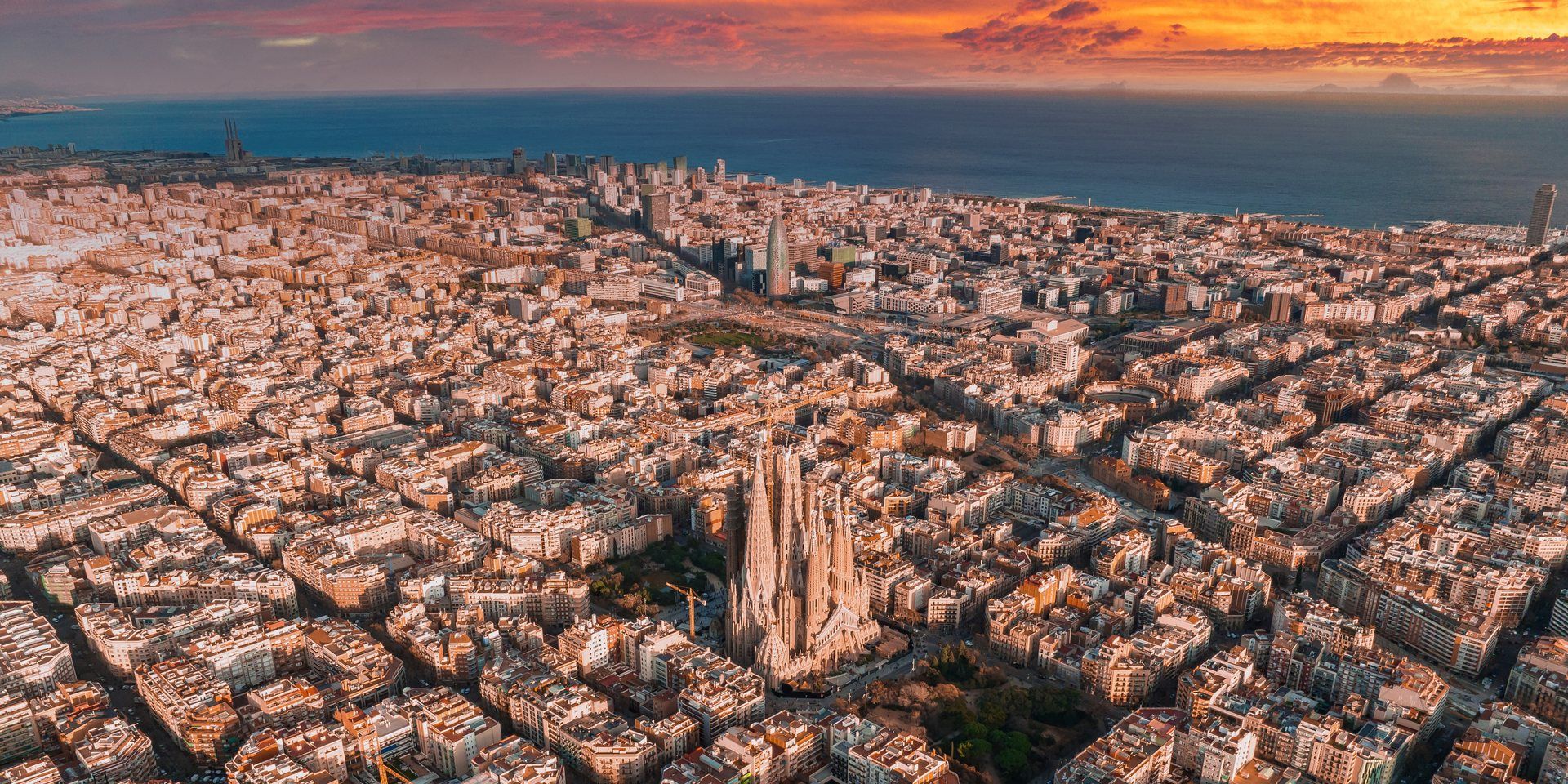
Around six in the evening, the Catalan light does what no monument can: it changes the city. The Eixample, the great grid drawn by Ildefons Cerdà in the nineteenth century, turns the colour of honey. Its corners are cut at forty-five degrees, originally to give the trams room to turn; their finer legacy is that every crossing opens into a small square where the sun lingers. You do not cross the Eixample so much as drift up it, unhurried, the way one follows a calm river.
The Passeig de Gràcia is its main channel. Along a little more than a kilometre, the avenue lines up the great houses of Catalan modernism, and Gaudí appears twice: first the Casa Batlló, its façade of scales and bone that seems to breathe, then La Pedrera, its stone rolling like a tamed cliff. There is no need to queue at this hour: these façades give their best from the opposite pavement, as the light drops and the stone turns from grey to gold. La Pedrera never wears the same face twice in a day; late afternoon is its finest.
Around you, the city slows. This is the hour of the passeig, the evening stroll, an institution nobody explains and everybody observes: one walks for the sake of walking, studies shop windows with no intention of buying, takes a terrace table without consulting the time. In the right company, the exercise becomes an art.
The Sun Goes Down
For what comes next, take some height. Montjuïc, the hill set between the city and the port, keeps its miradors: Barcelona spread on one side, the Mediterranean holding the other. One detail the postcards keep quiet: the sun does not set into the sea here, it slips away behind the hills inland. Which works rather well: while it sinks over land, the sea takes the light, low and coppery, turning the cargo ships offshore into shadow theatre.
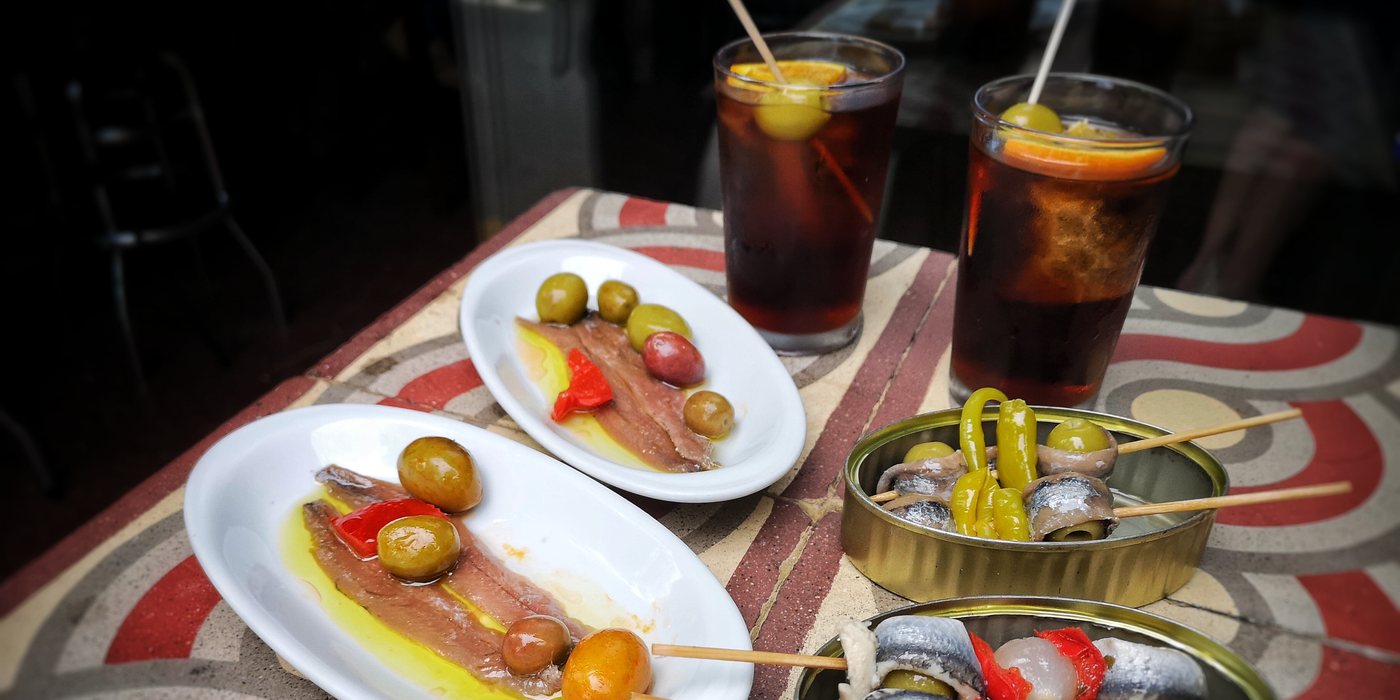
This is the hour of vermouth. The locals call it l'hora del vermut, a Catalan institution born in the late nineteenth century, when Italian vermouth first arrived through the port. Officially it belongs to midday, ideally a Sunday, before lunch; but nobody in Barcelona will hold a sunset vermut against you. Poured over ice with a slice of orange and an olive, it comes with good tinned fish and a gilda, that little skewer of olive, pepper and anchovy that wakes the palate. It is to the aperitif what the city is to travel: deeper than it looks.
Two glasses, the sea darkening by degrees, a conversation finding its stride: sunset may be the most generous hour of the Barcelona day. It costs nothing, and it cannot be rescheduled.
The Dinner That Refuses to End
Nobody dines early in Barcelona. Nobody dines late either: one dines on Barcelona time, which is to say rarely before half past nine. The dining rooms fill as elsewhere they empty, and that is the first pleasure of dinner here: nobody is waiting for you to leave.
The Catalan table lives between the sea and the mountains, and the repertoire is broad: pa amb tomàquet, bread rubbed with tomato and oil, something of a domestic religion here; anchovies; artichokes in season; rice that has taken on the taste of the sea; and tapas, which are not a menu but a way of holding a conversation with the kitchen. We shall not hand you a list of addresses; the good tables move on, and part of the pleasure is precisely not knowing in advance where you will dine.
What we do recommend without reservation is the sobremesa. The word names the time spent at the table once the meal is over, and that time is never measured: coffee, then something else, then nothing at all, and the conversation carrying on. No waiter will bring the bill unbidden; here, that would border on a lapse of taste. At weekends the sobremesa happily outlasts the meal itself. If your companion joined you at your hotel earlier in the evening, dinner is only the second act; the sobremesa is the third, and often the best: it is where the evening decides what it wants to become.
The Night
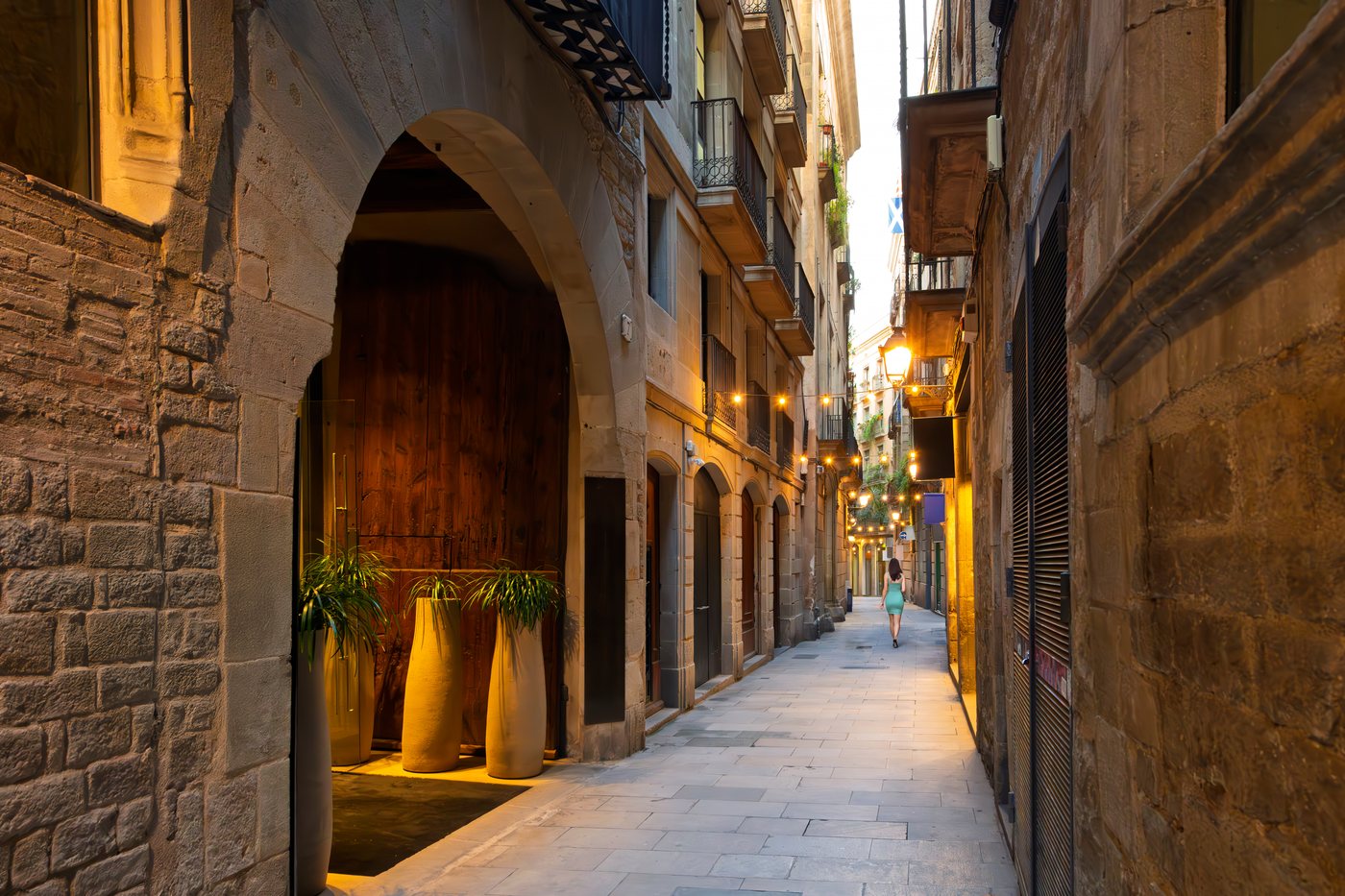
Towards midnight the city does not retire; it changes neighbourhood. Cross the Plaça de Catalunya and step into the Barri Gòtic. The Gothic Quarter is a medieval labyrinth that refuses to be tamed: one gets lost in it on principle, along lanes where two people can barely walk abreast, which is an excellent reason to walk closer. The cathedral appears without warning at the turn of a square; on the Plaça Reial, beneath the palms, the lampposts are the work of a very young Gaudí, who lit the city before he crowned it.
For a drink, cross over the Via Laietana into El Born: the old artisans' quarter has turned its medieval lanes over to wine bars, cocktail counters and late terraces, around the Passeig del Born and Santa Maria del Mar, a jewel of Catalan Gothic. The last drink is never planned. A hushed bar behind a discreet door, two armchairs, a short list: the city has plenty, and will find one for you. Then, if the night is mild, walk down to Barceloneta. The beach has nothing of the seaside about it at this hour; what remains is the promenade, a few silhouettes, and the Mediterranean breathing in the dark, invisible and entirely present. You find yourselves speaking more quietly for no reason at all. That is usually the sign of an evening well spent.
Where to Settle In
For the stay itself, the Passeig de Gràcia is the obvious answer: central, elegant, within walking distance of everything above. The Majestic has received guests there since 1918, held by the same family from the beginning, with an art collection a museum would envy and a rooftop terrace from which the Eixample reads like a map. A few steps away, El Palace, born as the Ritz in 1919, keeps the grand manner of its era: columns, high ceilings and old-school service. Down by the water, a handful of fine houses look the Mediterranean straight in the eye. All of them share the quality we value most: they know how to receive, and keep no memory of faces.
That last point matters, because our bookings take place at your hotel. We work on an outcall basis only: whichever hotel you have chosen, it is your escort in Barcelona who travels to you, arriving at the agreed time like someone you had been expecting. Our escorts understand the tempo that makes this city what it is: they fall into step with it by instinct, attentive without drawing attention, at ease in a sobremesa that stretches on.
In Barcelona nothing worthwhile is ever rushed; the best of it is savoured slowly, and in good company. If it is on your horizon, or if you would rather your companion travelled to you, write to us: we will prepare your visit with all the attention a city like this deserves.
Further reading
- UNESCO, Works of Antoni Gaudí, World Heritage (Casa Batlló, La Pedrera, Park Güell). whc.unesco.org
- Barcelona City Council, Catalan cuisine. meet.barcelona
- UNESCO, castells (human towers), Intangible Cultural Heritage. ich.unesco.org