
Open a map of Budapest and trace the river with a finger. The Danube does not pass through the city so much as compose it. Buda on the right bank, wooded, crowned by a castle. Pest on the left, flat and quick, its avenues drawn with a ruler and its evenings drawn out. Two temperaments joined in 1873, when Buda, Pest and Óbuda agreed to form a single capital. The marriage took; the difference, happily, remained.
That difference is what makes a weekend here worth having, and it changes what good company means. An escort in Budapest shows you not one city but two, held apart by a wide river and held together by some of the handsomest bridges in Europe. Every evening comes with its own natural route: one bank to begin, a bridge to change your mind, the other bank to end.
This guide therefore follows the river rather than the usual list of monuments: Buda first, then the Danube, then Pest. To plan the stay, our chosen addresses (hotels, restaurants, cafés and bars) are gathered on our Budapest page.
Buda, the High Bank
Buda has to be earned. You climb, by funicular or by the stairways that thread between gardens, and come out in the Castle District: cobbled lanes, pastel baroque façades, the hush of a small town perched above a capital. The Fisherman's Bastion lines up its seven white stone turrets, one for each of the seven Magyar tribes, and its terrace delivers the finest geography lesson in the country: all of Pest at your feet, the Parliament in the foreground, the river in between. A step back, and there stands Matthias Church, its glazed tile roof glinting like a single great scale.
Further south, Gellért Hill and its Citadella keep watch over the river. Buda is the bank of slow mornings: coffee on a terrace nobody walks past, long strolls under the trees, and the discovery that Budapest also knows how to hold its tongue. Come evening, when the day-trippers have gone back down, the Castle District recovers its lanterns and its residents; that is the hour we like best for walking it.
It is also the bank of hot water. The city sits on a field of thermal springs that earned it, long ago, its title of city of baths. At the Rudas Baths, built in the sixteenth century under Ottoman rule, the octagonal pool lies beneath a dome pierced with small openings; light falls in slanting shafts, steam softens every outline, and voices drop without anyone having agreed to it. The heat does the rest: it loosens the shoulders, slows the thoughts, returns to the body an attention modern life denies it. On the roof, an open-air pool at 36 degrees watches the Danube go by, and one winter evening up there explains why the people of Budapest have never given up the ritual. The Gellért Baths, the Art Nouveau masterpiece at the foot of the hill of the same name, have withdrawn for a complete restoration; they will be back. Until then, Rudas carries the rite perfectly well: enter, slow down, say little, come out lighter.
The River Between
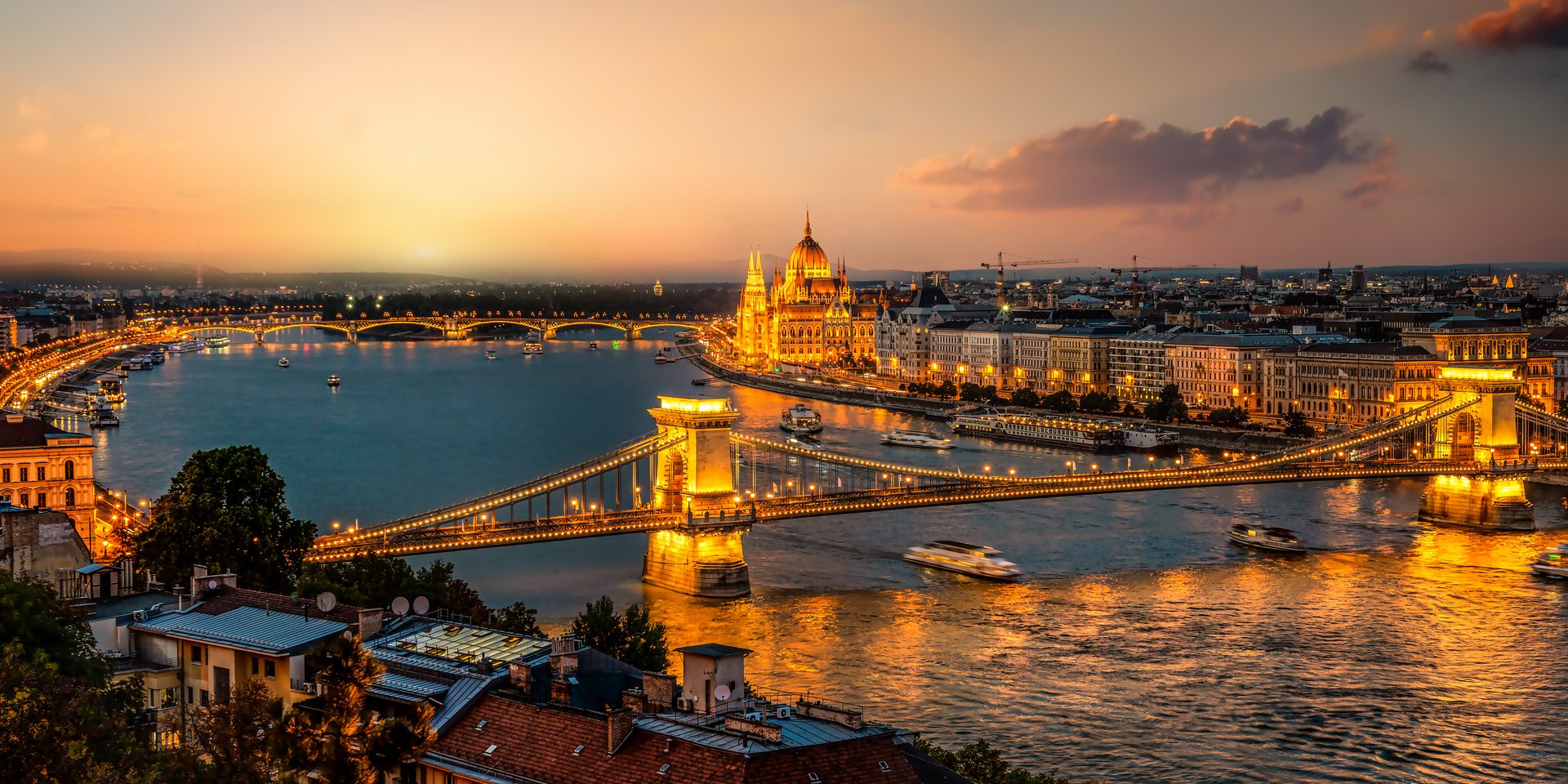
Which leaves the bridges, and first among them the first. The Chain Bridge, Széchenyi lánchíd to Hungarians, opened in 1849: the first permanent crossing of the Danube between Buda and Pest, guarded at either end by its stone lions. It was read from the first as a sign that the two towns would end up as one; history proved the point twenty-four years later. Before it, one crossed by boat, or over the ice when winter allowed. Ever since, crossing has been the city's founding gesture, made ten times a day without thinking and once an evening thinking of little else.
For at night the river gives its performance. The Parliament, a neo-Gothic vessel completed in 1904 and set at the water's edge on the Pest side, lights up first; the castle answers from its hill, and the bridges follow one by one. The embankments were made for slow walking, shoulder to shoulder, with no plan beyond the reflections. A dusk cruise earns its keep too, a glass of white Tokaj in hand: an hour on the water, and Budapest slides past like a stage set built to order.
Midstream, Margaret Island serves as the city's parenthesis: an entire park set upon the water, shaded alleys, old plane trees, morning runners and Sunday strollers. Neither Buda nor Pest, it is the one place in the city where you stand truly between the two banks, which makes it the ideal walk for anyone unable to choose.
Pest, the Lively Bank
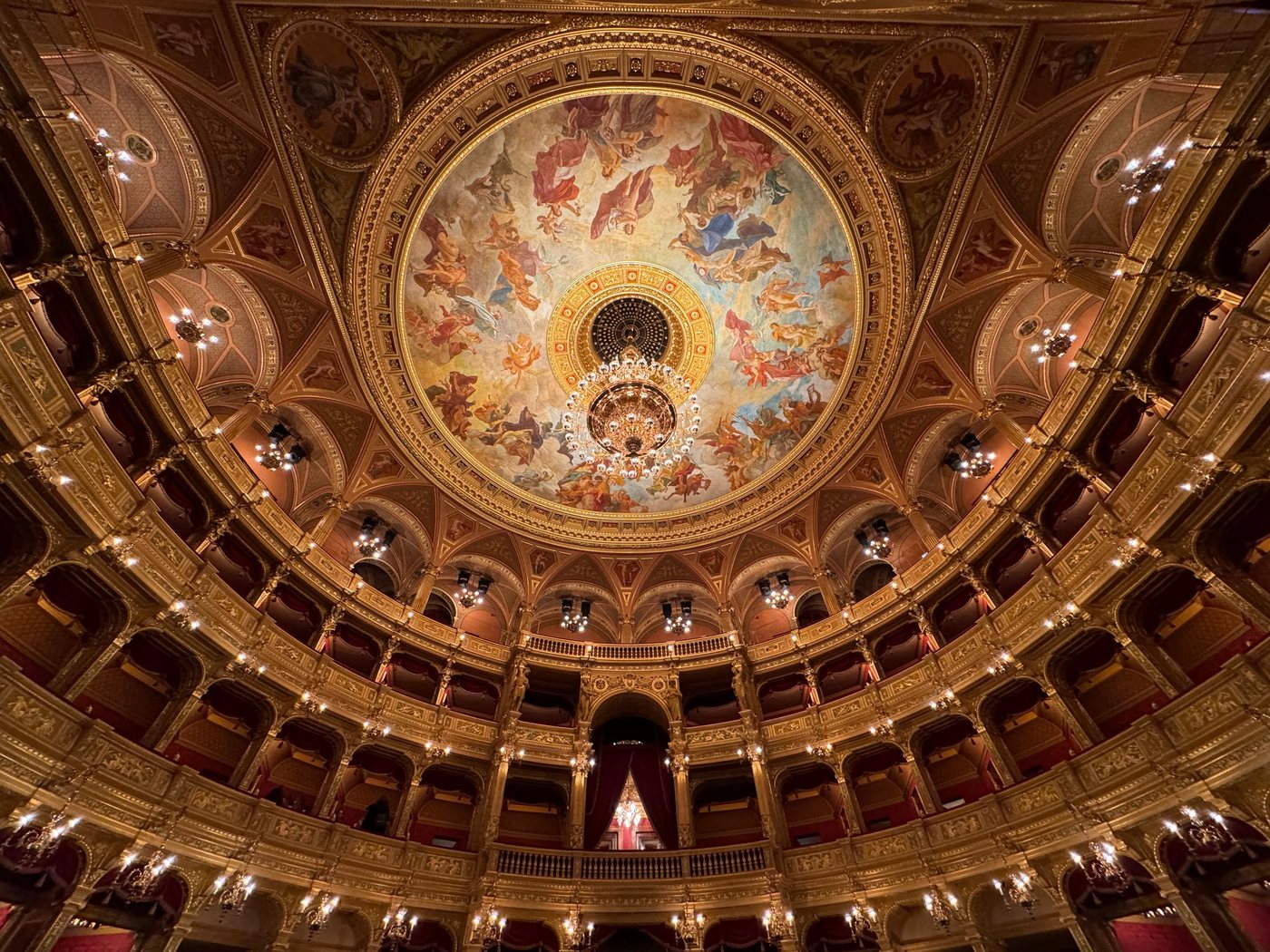
Pest does not climb; it advances. Andrássy Avenue, laid out in the nineteenth century and listed by UNESCO, runs dead straight towards Heroes' Square, doubled underground by continental Europe's oldest metro line, opened in 1896. Along the way the State Opera House presents its neo-Renaissance façade by Miklós Ybl; a few streets over, St Stephen's Basilica, the largest church in the city, closes the view with its dome. An evening begins well at either.
Pest also perfected an institution: the grand café. Painted ceilings, gilt, waiters in black waistcoats, pastries built like small monuments; the world has been put to rights here since the nineteenth century, and nothing suggests the habit will stop. Come evening, the bank quickens: in the old Jewish quarter, the ruin bars, the romkocsmák set up in the courtyards of derelict buildings, have their folklore and their crowds. But the real Pest evening happens at a table. A discreet restaurant, a Hungarian wine list worth exploring beyond Tokaj, a conversation with time on its side. It is an evening the escorts in our gallery know well: a table booked under a first name, an unhurried dinner, then the walk back along the lit river.
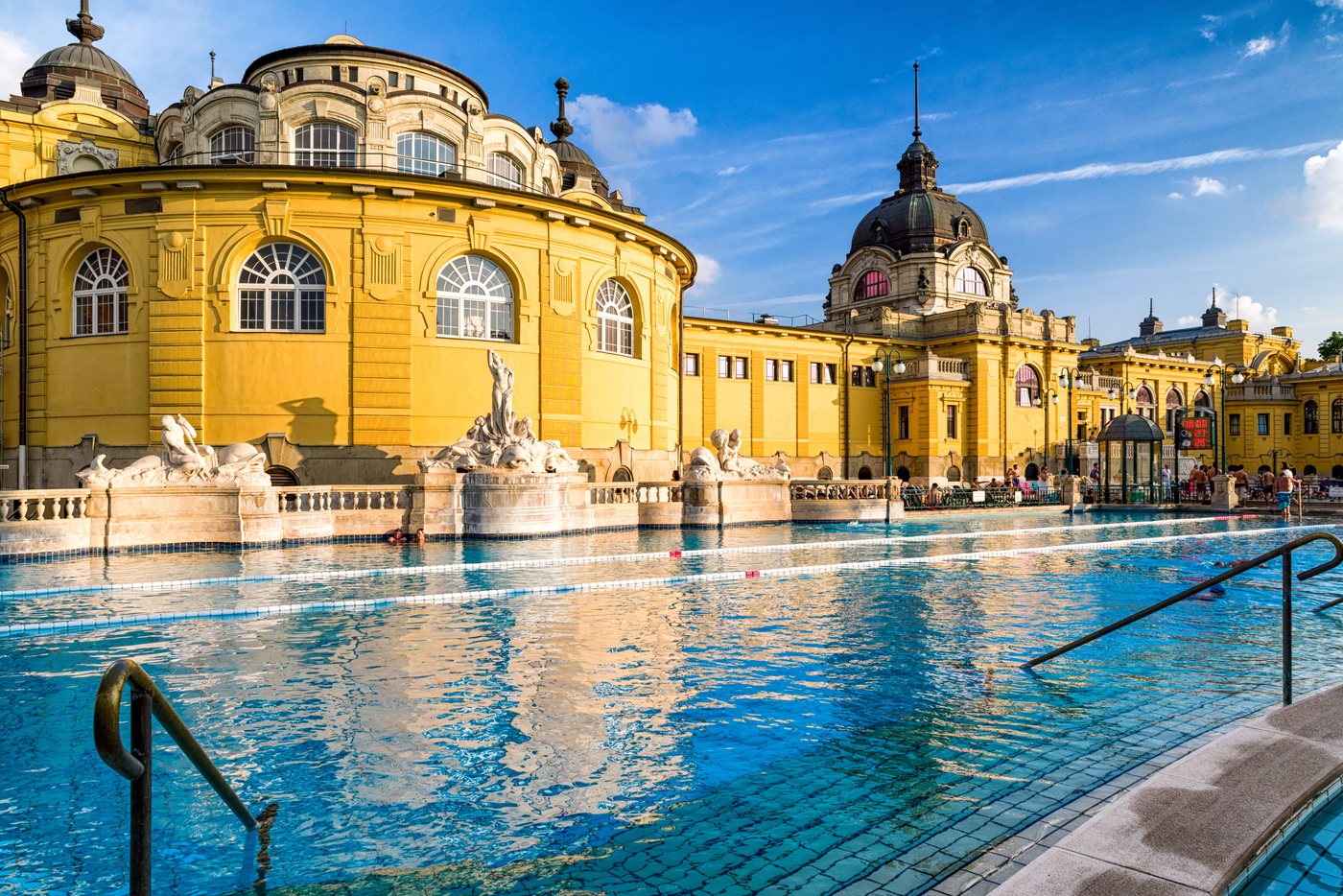
And Pest keeps baths of its own: Széchenyi, in the City Park, the largest in the capital, neo-baroque and sunshine yellow. Its outdoor pools steam in midwinter while chess players contest their games in the water, and the whole place sets its cheerfulness against the half-light of Rudas: two banks, evidently, even in the steam.
Choosing Your Bank
The question in Budapest is not finding a fine hotel; it is choosing your bank. Buda, on the castle side, offers calm, plunging views and addresses of character on the hillside. Pest lines its grand hotels along the Danube and around the basilica and Andrássy: you stay at the centre of everything, ten minutes on foot from the Opera and from the embankments alike. If the view matters to you, our advice is brief: a river-facing room, on either bank; in Budapest, the window is part of the stay.
The rest does not change from one side to the other: we work exclusively on an outcall basis, and it is your hotel of standing that hosts the booking, at the hour settled with the agency. Your escort arrives the way one meets someone in a hotel bar, without ceremony and without an audience, for a dinner in Pest, a full evening, or the three days that suit the city best.
Two banks, one river, and the urge to cross: if a weekend in Budapest is taking shape in your plans, write to us with your dates and preferences, and we will compose the rest with you. And if life keeps you elsewhere, your companion can just as well travel to you.
Further reading
- UNESCO, Budapest, including the Banks of the Danube, the Buda Castle Quarter and Andrássy Avenue, World Heritage. whc.unesco.org
- Visit Hungary, the Széchenyi Chain Bridge. visithungary.com
- Visit Hungary, Andrássy Avenue. visithungary.com